



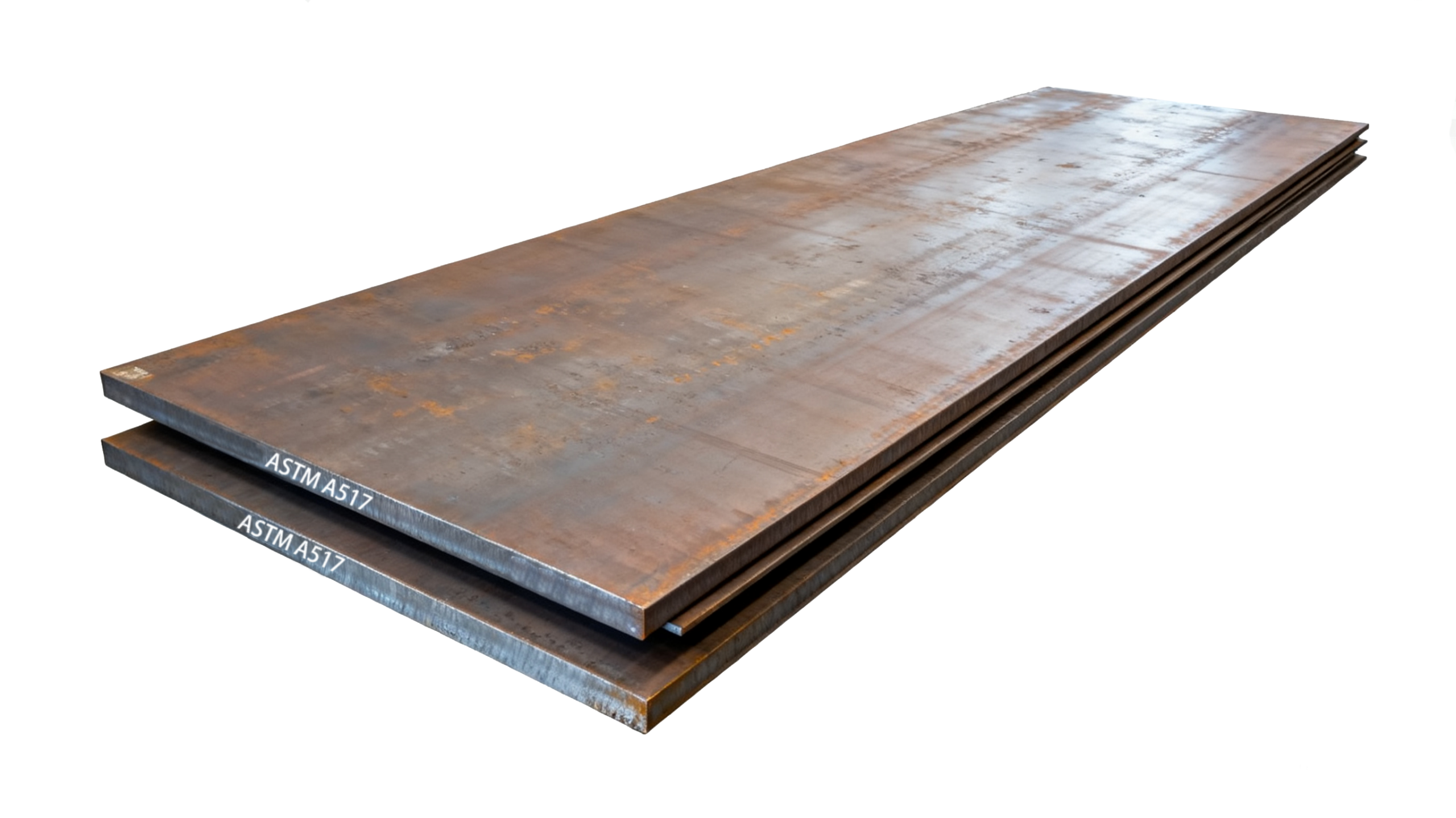
ASTM A517 steel plate
Product Application: Used as key welding components for high-pressure vessels, drilling platform structures, oil and gas pipelines, manufacturing crane arms, excavator bucket rods, loader frames, support structures for offshore platforms, ship decks, pressure bearing components for low-temperature pressure vessels and power plant boilers, high-strength load-bearing components for bridges and buildings, as well as wear-resistant and impact resistant components for mining machinery and other welding structural components used to withstand high stress, low-temperature environments or dynamic loads.
Delivery conditions:The goods can be delivered under various conditions, such as hot rolling, normalization, tempering, quenching, N+T, T+Q, etc.
Specifications & Standards:Refer to the table below
Consultation Hotline: 0086-371-55023661
| Category | Details |
|---|---|
| Executive Standards | ASTM A517/A517M-17 |
| Grade Classification | Grade A, B, E, F, H, P, Q, S (different chemical compositions per grade, consistent mechanical properties) |
| Thickness Range | 3 – 300 mm (grade-specific thickness limits: A/B ≤ 32mm, H/S ≤ 50mm, F ≤ 65mm, P ≤ 100mm, E/Q ≤ 150mm) |
| Width × Length | 1500 – 4200 mm × 3000 – 18000 mm (custom sizes negotiable) |
| Chemical Composition (%) (Melting Analysis) | Grade B: C 0.15-0.21, Si 0.15-0.35, Mn 0.70-1.00, P ≤ 0.035, S ≤ 0.035, Cr 0.40-0.65, Mo 0.15-0.25, B 0.0005-0.005, V 0.03-0.08, Ti 0.01-0.03 Grade S: C 0.10-0.22, Si 0.13-0.45, Mn 1.02-1.62, P ≤ 0.035, S ≤ 0.035, Ti 0.07, Cb 0.07, Mo 0.10-0.38 Grade P: C 0.10-0.23, Si 0.18-0.37, Mn 0.40-0.78, P ≤ 0.035, S ≤ 0.035, Ni 1.15-1.55, Cr 0.79-1.26, Mo 0.41-0.64, B 0.001-0.005 Other Grades: Performance optimized by adjusting alloy elements (e.g., Grade E contains 1.40-2.00% Cr) |
| Mechanical Properties | Thickness ≤ 65mm:Yield Strength: ≥ 690 MPa Tensile Strength: 795 – 930 MPa Elongation: ≥ 16% (2-inch gauge length) Low-Temperature Impact Energy: ≥ 60 J (-40℃, transverse Charpy V-notch) Thickness 65-150mm: Yield Strength: ≥ 620 MPa Tensile Strength: 725 – 930 MPa Elongation: ≥ 14% Reduction of Area: ≥ 45% (round specimen) |
| Heat Treatment State | Quenched + Tempered (heated to ≥ 900℃ for quenching, ≥ 620℃ for tempering) |
| Processing Technology | Supports cutting, welding, bending, and machining. Welding requires low-hydrogen process and heat input control |
| Application Fields | Pressure Vessels: High-pressure reactors, LNG storage tanks, power plant boilers Offshore Engineering: Drilling platform racks, marine support structures Heavy Machinery: Mining shovels, crane booms, hydraulic supports Petrochemical Industry: Key oil pipeline components, oil refining equipment Low-Temperature Environments: Impact-resistant structures for working conditions below -40℃ |
| Inspection Requirements | Tensile test, low-temperature impact test, hardness test- Ultrasonic flaw detection (optional supplementary requirement S18) Provide EN 10204 3.1/3.2 certificate |
Friend links:HENAN STEEL GUANG INTERNATIONAL TRADE CO., LTD.







Global Hotline: 0086-371-55023661 Email: info@steelguang.com
Copyright © 2019 HENAN STEEL GUANG INTERNATIONAL TRADE CO., LTD.
Global Hotline:0086-371-55023661
Copyright © 2019 HENAN STEEL GUANG INTERNATIONAL TRADE CO., LTD.